
Van bulkhead: is it compulsory or not?
A van bulkhead is not compulsory: you can remove it from your van without going through the DREAL (the French authority that approves vehicles), without changing the registration certificate and without risking a retest. On forums, however, the question sparks the same debates every week, often based on “someone told me”. Here, every claim points to a text you can open and check. And we will go further than most articles on the subject, by citing the only European rule that genuinely deals with separation between the cab and the load area.
The answer in 20 seconds
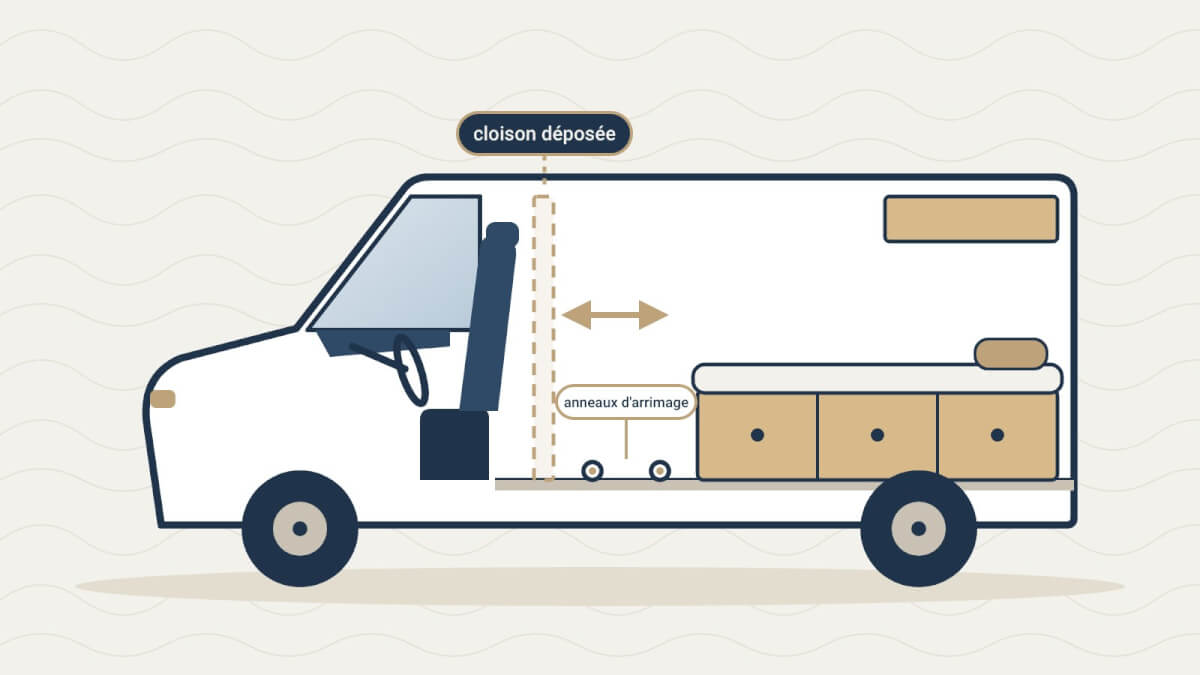
- No text requires a bulkhead on a van approved as a commercial vehicle (CTTE type, the French vehicle type for light goods vehicles): European law instead accepts lashing points in the floor.
- The roadworthiness test (contrôle technique, the French MOT equivalent) does not check for the presence of the bulkhead, only how tidily it was removed.
- Removing a bolted-in bulkhead changes no box on the registration certificate.
- The real limit: nobody travels in the back outside the seats listed on the registration certificate.
Contents
Why is the van bulkhead such a debated topic?
Nobody can show you the article of law that says “the bulkhead is not compulsory”, for a simple reason: no text lists what it does not require. This gap leaves plenty of room for rumours. The right approach is therefore to do the opposite: open the texts that set out what is required, and see that the bulkhead is not in them.
Three misunderstandings that fuel the rumour
- The May 2018 reform of the roadworthiness test tightened checks on fixed conversions: a converted van that is not approved as VASP (the French “motor caravan” special-purpose vehicle category) must be presented empty. Many people wrongly concluded that everything inside the vehicle was now being monitored.
- The ISO 27956 standard describes how to design a bulkhead or lashing points capable of restraining a load. It is a technical standard, often mistaken for a law.
- Prevention advice aimed at tradespeople: the INRS (the French national institute for occupational health and safety) recommends a bulkhead for professionals carrying heavy tools. It is good advice, not an obligation.
Common myths: true or false
| What you read on forums | What the texts say |
|---|---|
| “The bulkhead has been compulsory since 2012.” | No text carries that date. The ISO 27956 standard, often cited, dates from 2009 and is not aimed at the owner of a van already on the road. |
| “Without a bulkhead, the roadworthiness test will be failed.” | No inspection point covers the bulkhead (order of 18 June 1991, annex I). |
| “Without a bulkhead, the van is no longer a commercial vehicle.” | European law accepts lashing points in place of a partition: the CTTE type does not change. |
| “Without a bulkhead, you have to re-register as VASP.” | The VASP motor caravan category requires fixed living equipment (bed, table, kitchen, storage). The bulkhead is not part of it. |
| “You need written agreement from your insurer.” | No information in the policy changes, so there is no obligation to declare it. A simple email is still a sensible precaution. |
What does European regulation say about separation between the cab and the load area?
Here is the point almost every article overlooks: one text does deal with separation. And it is precisely this text that proves the bulkhead is not compulsory.
The rule: separate, or secure
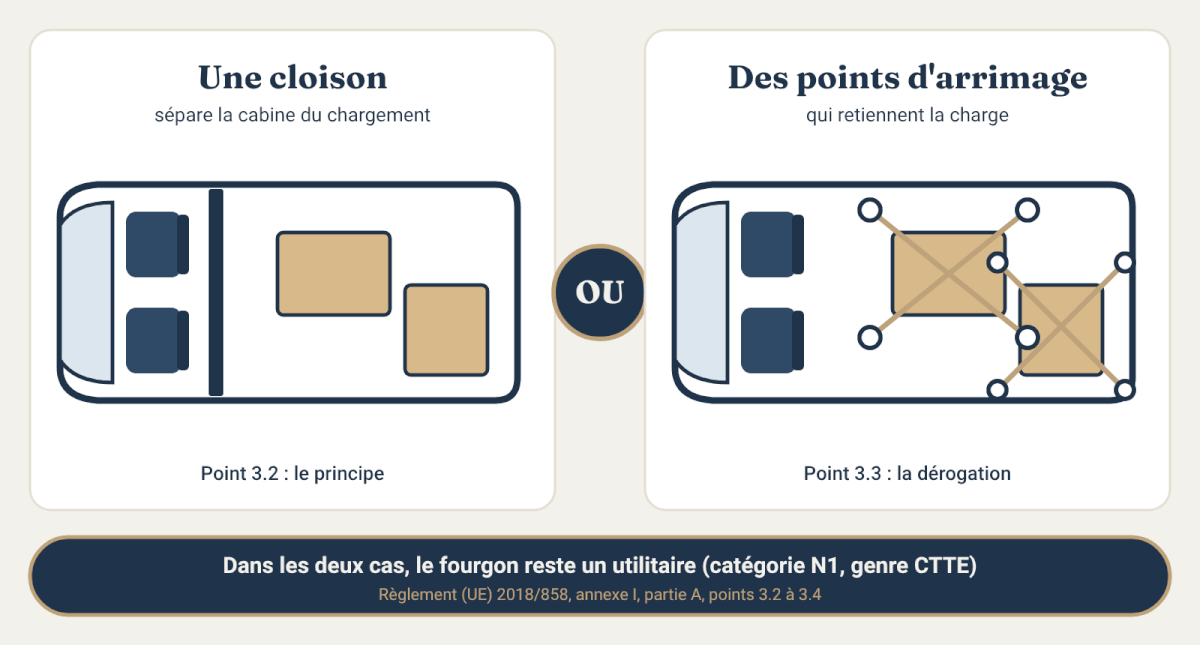
Regulation (EU) 2018/858 sets out, in its annex I, the criteria for classifying a vehicle in category N, that of goods vehicles. Its point 3.2 lays down a principle: the seating area must be entirely separated from the load area. But point 3.3 immediately provides for an exemption: passengers and goods may share the same space if the load area is fitted with securing devices that protect the occupants during sudden braking or cornering.
Point 3.4 specifies that these devices, like bulkheads, must comply with the ISO 27956 standard. This standard is therefore not a mere recommendation: European law refers to it. But it is aimed at the manufacturer, at the time the model is approved, and it leaves two possible routes. The rings fixed to your van's floor are precisely the second one.
The other technical requirements do not mention it
The equipment required on a new vehicle is listed in annex II of the same regulation, a closed list of subjects: braking, lighting, seats, seat belt anchorages, mirrors… None of them concerns a bulkhead. The only area that comes close, “interior fittings” (UN Regulation No. 21), applies only to category M1 passenger cars, not to commercial vehicles.
Proof from the manufacturers
If the bulkhead were essential, no manufacturer would sell a van without one. Yet Volkswagen offers a “No bulkhead pack” on the Crafter, priced at €0 excl. VAT in its 2026 Crafter price list. Chassis-cab versions, sold to coachbuilders and motorhome manufacturers, also leave the factory with no partition at all behind the seats.
For our Belgian readers, a special case: Belgium requires a bulkhead at least 20 cm high to convert a car (M1) into a light van (N1). This rule targets converted cars, not vans approved as commercial vehicles straight from the factory.
Is the bulkhead checked during the roadworthiness test?
No. The roadworthiness test for vehicles under 3.5 tonnes follows the order of 18 June 1991, whose annex I lists the points to be checked. The inspector can only record a defect provided for in that list. In the technical instructions that detail it, functions 6 (“chassis and chassis accessories”) and 7 (“other equipment”) contain neither the word “bulkhead” nor the word “partition”.
An inspection body has also confirmed this to us, as we explain in our FAQ on van conversions: removal of the bulkhead is not checked. What can be checked are the traces of a removal done too hastily.
What the inspector can flag after a sloppy removal
| What you leave behind | Inspection point | Severity |
|---|---|---|
| Fixing holes or cut-outs in the floor | 6.2.4 Floor | Major (retest) |
| Bracket, sheet metal or screw sticking out that could cause injury | 6.2.1 Cab and bodywork, 6.2.9 Other interior fittings | Major |
| Loose or damaged seat belt anchorage | 7.1.1 Seat belts and anchorages | Major, critical if torn out |
| Structural element cut | 6.2.1 Structural modification | Major |
If your van is fitted with a removable conversion, present it empty at the test: the inspector must see the vehicle as it was approved. Everything is detailed in our guide to the roadworthiness test for a van without a bulkhead and a converted van that is not VASP.
Do you need to declare the removal of the bulkhead (registration certificate, DREAL, insurance)?
No individual approval
Article R321-16 of the French Highway Code requires a new approval only in the event of a “substantial modification”, a notion defined by article 13 of the order of 19 July 1954. In essence, this is a modification that changes the vehicle's status with regard to the rules on category, weight, dimensions, lighting or braking, or that alters a technical entry on the registration certificate.
Removing a bolted-in bulkhead affects none of this. The type (box J.1), the body (J.3), the maximum masses (F.1 and F.2) and the number of seats (S.1) remain the same. No DREAL, no new registration certificate: your van remains a CTTE.
No VASP either
The VASP “caravan” category corresponds to a vehicle fitted, in a fixed way, with seats and a table, a bed, a kitchen and storage. The bulkhead meets none of these criteria. Neither does a removable conversion, as long as it can be dismantled and the vehicle is presented empty at the test.
And insurance?
Article L113-2 of the French Insurance Code requires you to declare, within fifteen days, any new circumstances that increase the risk or make the answers given when taking out the policy inaccurate. Removing a bulkhead changes neither the vehicle's type, nor its use, nor its power, nor its number of seats: it is therefore not an obligation. An email to your insurer is nonetheless a free precaution, especially if you then install a valuable conversion.
Without a bulkhead, which rules really apply?
The absence of a bulkhead requirement does not mean “anything goes”. Three articles of the Highway Code apply to all vehicles, with or without a bulkhead.
- The load: under article R312-19, “all necessary precautions must be taken to ensure that a vehicle's load cannot cause damage or danger”. The text sets an outcome, not a method: bulkhead, straps, net or well-secured furniture, the choice is yours.
- Driving: article R412-6 prohibits the driver's movements and field of vision from being restricted by the items carried. It is a class 2 offence, with possible immobilisation of the vehicle.
- Passengers: article R412-1-1 requires them to be carried on seats, within the limit of the seats listed on the registration certificate. A person sitting in the back on a mattress or a chest means a €135 fine and 3 penalty points. This is the real risk: removing the bulkhead does not create any seat. To carry more people, you must add a rear bench seat to the van in compliance with the rules, and in that case a visit to the DREAL is necessary.
A bulkhead is not an airbag
In its brochure “Choisir son véhicule utilitaire léger” (Choosing your light commercial vehicle), the INRS points out that at 50 km/h, an unsecured load is thrown forward with a force of 20 to 40 times its weight. A 15 kg cool box then pushes like a mass of 300 to 600 kg. And in crash tests at 50 km/h, the INRS found that “bulkheads can generally only restrain a load of less than a few tens of kilograms”.
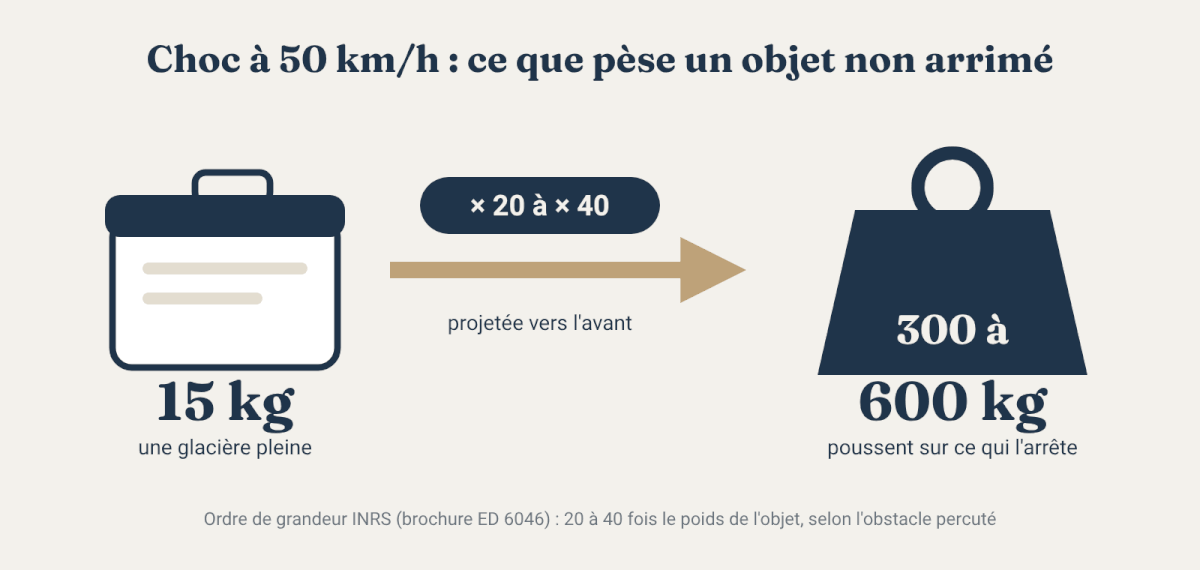
Conclusion: what really protects the occupants is securing the load, not the partition. For professional use, the employer remains required to assess risks (article L4121-1 of the French Labour Code), and the bulkhead may be among the measures adopted in the risk assessment document. For a leisure van, the aim is the same: nothing should fly around when you brake.
How do you remove the bulkhead from your van without creating problems?
On a recent van, removal often comes down to a few bolts. Three checks will nonetheless help you avoid unpleasant surprises.
Before you get your tools out
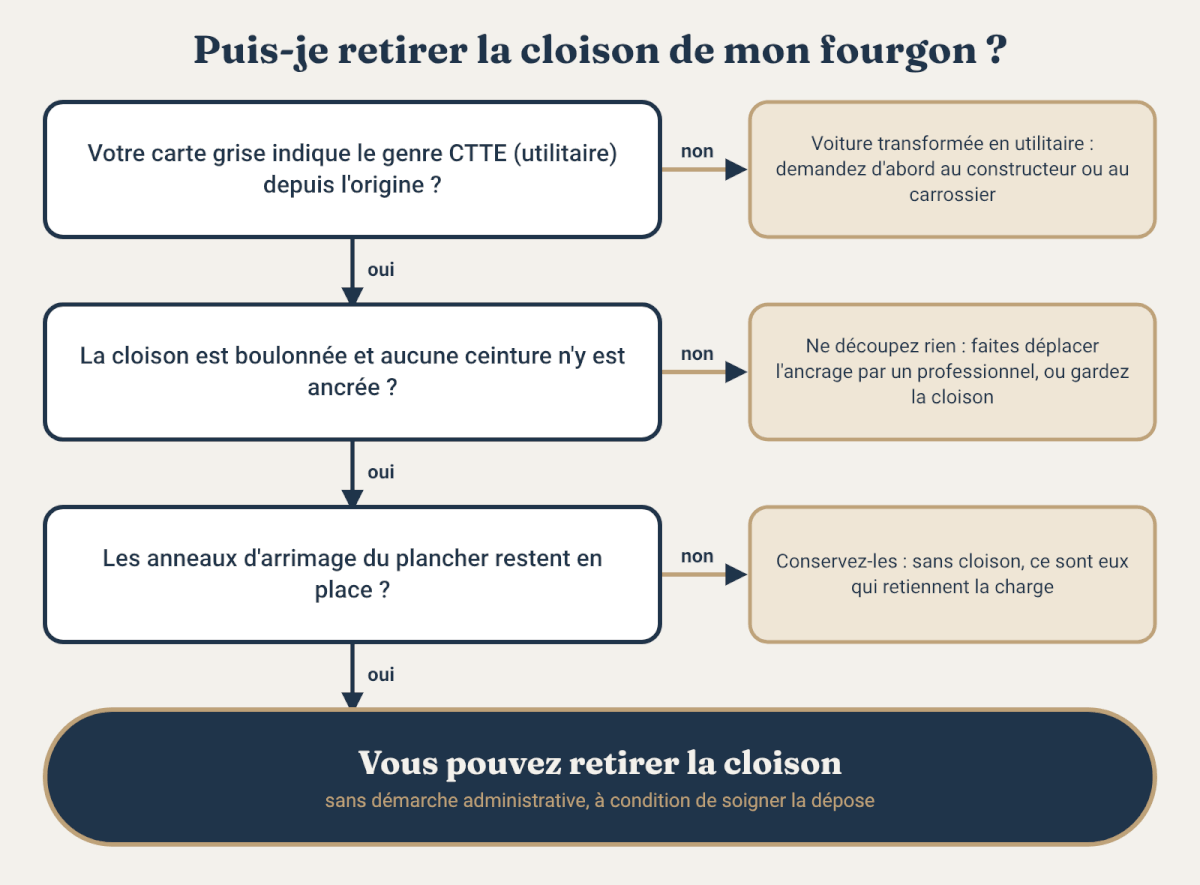
- Check the registration certificate. The type must have been CTTE from the outset. For a car converted into a commercial vehicle (a car-derived van), first ask the manufacturer or the coachbuilder that carried out the conversion.
- Locate the fixings. On most recent vans, the bulkhead is bolted to the floor and to the pillars. If it is welded or contributes to the rigidity of the body, do not cut it out.
- Look for seat belt anchorages. On some cabs, a seat belt or its reel is fixed to the bulkhead. In that case, keep it, or have the anchorage relocated to the structure by a professional.
After removal: the checklist
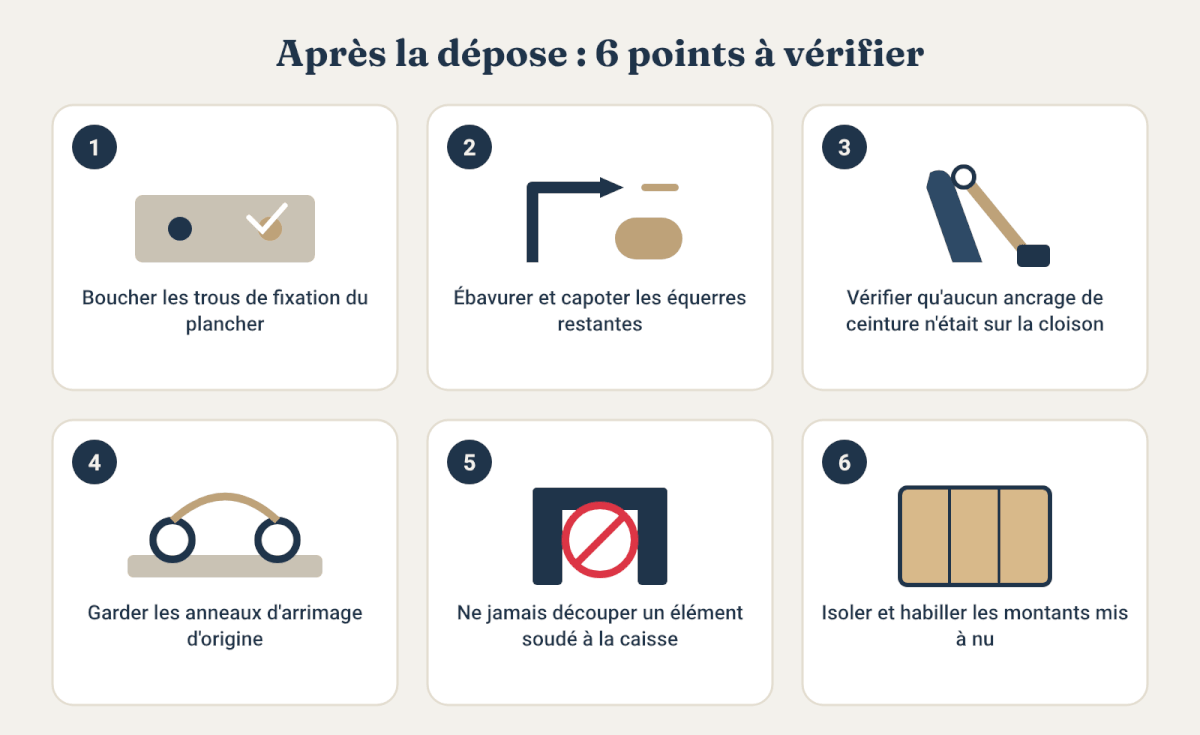
- Plug the fixing holes in the floor (plugs, filler or riveted sheet metal): a perforated floor can mean a retest.
- Deburr and cover any brackets or tabs left on the pillars.
- Check the seat belt anchorages once the bulkhead has gone: they must be tight and intact.
- Keep the original lashing rings: they are what replace the bulkhead under the European regulation.
- Do not touch the structure: no cutting into any element welded to the body.
- Line the pillars and the exposed roof: this is the right time to insulate.
Keep the bulkhead and its fixings: when you sell, a professional buyer may ask you for it.
What can you do with the extra space once the bulkhead is removed?
Without a bulkhead, the cab and the rear become a single space. You go from seat to bed without stepping out into the rain, the light from the windscreen fills the whole vehicle and the interior looks much bigger. In a compact van, you notice the difference from the very first night.
This is exactly Combeing's philosophy: a removable van conversion, installed without drilling, which you take out in a few minutes to get your van back or to take the roadworthiness test. Before installing it, take advantage of the removal to treat the walls: our sprayed cork insulation covers the pillars and the roof in one go.
Your van is ready, and so is the kit
Removable bed, storage and kitchen, compatible with more than 300 vehicle models.
Discover our kitsFrequently asked questions about the bulkhead
Article up to date as of October 2026. It sets out the texts currently in force and does not replace legal advice: if in doubt about a specific vehicle, ask its manufacturer.
Transform your utility vehicle into a camper van in 5 minutes.
Combeing is the ideal solution for owners of utility vehicles, vans, and campers who want to temporarily repurpose their vehicle for leisure in just a few minutes.
224 reviews
What our customers say...

Alain Martin

1 year(s) ago

Welcoming, very professional and competent team, very practical, functional and quality equipment, well done, great company, well-deserved stars.

salmandra x.
1 year(s) ago
I had put my kit in the basket. Sent an email with a question, Mathieu called me straight away, and even advised me on a better configuration. Appointment made 2 days after installation, with removal of my partition. And I was so well received that I added the kitchen module. A lovely, warm team. Go there with your eyes closed. I'll go back and do my insulation later... Thanks again... Sandra

Morane Barguillet
1 year(s) ago
We ordered our kit in September 2023 for our Opel Vivaro H1L2, we have used it well and made it profitable since. Received on a pallet with a very fast turnaround. A smooth and simple installation with several layout choices. We do not regret our investment. The materials after a year and a half are like new, you just have to take care of them. I recommend ??

Joel Joel
1 year(s) ago
5 stars well deserved. Great team A simple email resulted in a purchase. I felt considered, taken seriously and at the center of attention Once there, Matthieu was more than incredible. Really at the top. Knew how to satisfy, fulfill all my wishes. The family thanks you.

Hervé LOZES
2 year(s) ago
Ingenious and really well thought out concept, quality material and precision manufacturing, with a responsive team, I highly recommend!

Laetitia Coudrai
2 year(s) ago
We bought a Combeing kit a few months ago for our VW T5 transporter and we are very satisfied with it! Delivery was free and fast. Customer service is top notch, whether for information or responsiveness. The kits are adaptable to your type of vehicle but also to your use whether it is road mode, night mode or day mode (with table). Very good value for money. We highly recommend. And a big thank you to Mathieu for sending goodies!!

Laurent Gréco
2 year(s) ago
A great team, a high-quality product, a very competitive price. We sold our converted van because our annual usage time did not justify such an expensive investment. We bought a utility vehicle that we converted to our taste with the possibility of modifying its configuration according to our needs following the many very professional tips received from COMBEING. The team took the time to welcome us into the company and to assemble our modules in order to have a tailor-made layout with everything necessary to live independently: gas, water point, electricity, toilet, solar panel, shower... In short, everything necessary to live pleasant moments according to our desires without having to have our vehicle approved in VASP. Thanks again to the whole team for their welcome, their availability and their professionalism which really deserve to be highlighted

Domie Palet
2 year(s) ago
Very satisfied with the modules, fast delivery, a super friendly team, thank you Mathieu for his advice and his professionalism, the best!!!! We recommend without moderation...

Johann Manassian
2 year(s) ago
Really great, the team is really cool, the products sold (sports kit for VW T6 for me) are really great (but I didn't doubt that, I had already planned everything thanks to their website, but with their advice I made some changes that suit me better). I also did the sprayed cork insulation before going to get my kit, super simple and beautiful rendering. I really recommend more than ever. Thank you and good luck in your new premises.

caroline faure
3 year(s) ago
5 stars without hesitation for this professional company for the modular fitting out of Vans and Campers. Special dedication to Mathieu, who was able to listen and find all the solutions to my constraints while respecting my budget! The team is great, the atmosphere friendly! I recommend!!

Laurent FOUCHARD
3 year(s) ago
I was looking for a van that could be used as a daily, utility or leisure vehicle and with the Combeing Full kit, I found exactly what I wanted for my L1H1 van. I spoke several times with Mathieu and Raphaël, their listening, their responsiveness and their availability as well as their advice and services were very valuable in guiding me in my choices... In short, very well-made kits, easy and quick to set up, as well as a great team mean that I highly recommend this friendly company...

Stephane Picard
3 year(s) ago
We made an appointment, Mathieu welcomed us warmly and showed us around the workshop, then we went to the selection area to recap and make the quote. We had all the necessary technical explanations as well as his advice and feedback. The guy is sincere and super professional. Our choice validated, he helped us throughout the time needed to set up the modules. Again, lots of advice and tips, thanks to him. I thought the idea was absolutely brilliant on paper but it's even better in the van, the possibilities are endless, the quality is great, everything is thought out down to the smallest detail. In the end, it confirms that with my 1m70 we can sleep across without any problem and therefore keep the table in place during the night. Conclusion: we are satisfied beyond our expectations. Thank you COMBEING, thank you to the brilliant inventor and thank you Mathieu for your advice
Our strengths & values
No VASP approval required
Shipping within 48 working hours
Come and leave with your kit
Local and artisanal production
Low ecological impact
Professional integration (ESAT)
Infinite combinations to suit your wishes
Our kits adapt to all types of vans. Combeing selects the appropriate floors for your utility vehicle; you will just need to move the boxes around on this floor as you see fit. In just a few seconds, switch from a configuration with a table and seats to a large bed that covers the entire interior of the vehicle.


